28 October 2026 — Secure House Admin
Communal Entrance Doors: Key Security Features for Flats and Apartment Buildings
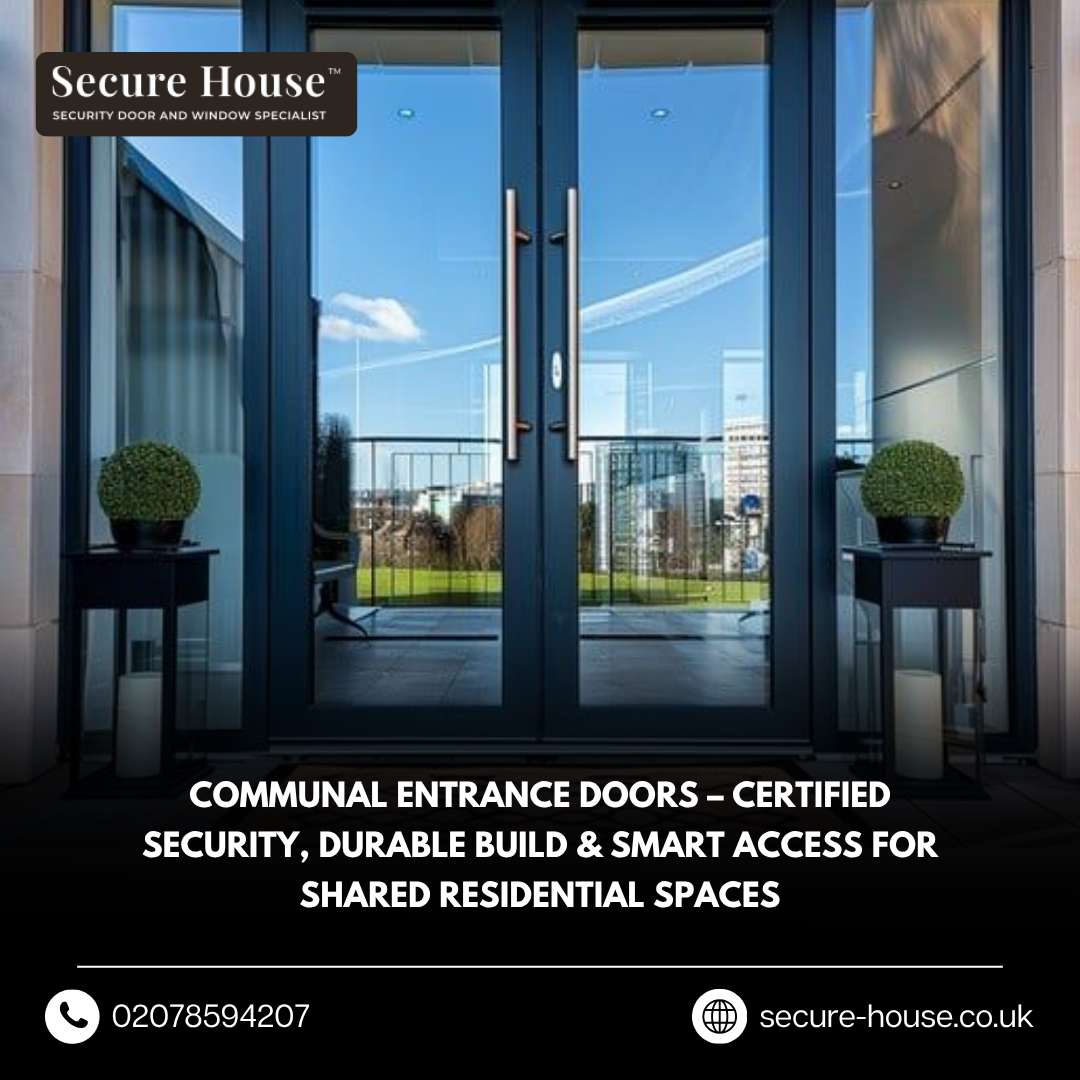
A communal entrance door is the shared main door of a block of flats, the point where residents, visitors and deliveries pass from the street into a building that other people call home. It has to keep unauthorized people out, let residents in without fuss, open quickly in an emergency and withstand heavy daily use. Those demands pull in different directions, which is why specification matters more here than for a single front door.
This guide sets out the security features to look for, explains how access control, fire safety and accessibility affect the choice, and covers how to keep a shared door working over the years. It is written for property managers, landlords, freeholders and residents' groups.
What is a communal entrance door and how does it differ from a flat front door?
A communal entrance door serves everyone in the building, while a flat front door serves one household. That difference changes the specification. A shared door is used many times a day by different people, is operated by residents who do not own it, and is often the only barrier protecting a stairwell, post area and storage rooms.
Communal front entrance doors therefore need stronger hardware, more tolerant mechanisms and a clear owner for maintenance, usually the managing agent or freeholder. Secure House supplies communal entrance doors as swing doors for lower-traffic entrances, automated sliding doors for busy ones, custom designs and storage doors.
What security features should communal entrance doors have?
Look for a reinforced frame and leaf, multi-point locking with anti-drill protection, tamper-resistant hinges, security glazing and independent certification. The aim is for communal security doors to resist forced entry while still working reliably with the building's entry system.
Frame and leaf
A steel frame and solid leaf resist levering and impact better than lightweight alternatives. Secure House states that its communal doors use reinforced steel frames, with the top model offering steel panels up to 115 mm thick.
Locking
Multi-point locking secures the door at several positions, and manganese or similar plates protect the lock area from drilling. Secure House lists multi-point locks, deadbolts, keyed locks and electronic access options for its communal range.
Hinges
Hinges are a frequent point of attack on busy doors. Look for reinforced hinges and bolts that stop the door being lifted from its frame.
Glazing
Vision panels help residents see who is outside, but glass is a weak point unless it is security-rated. Partially glazed and fully glazed options exist, and the glass should be laminated or security-rated, with panels placed away from the lock area.
Certification
Secure House states that its communal doors are graded to EN 1627:2011 and PAS 24. Ask for the current certificates covering the exact configuration you are buying, including any glazing and access hardware. The security levels page explains how burglar-resistance classes are described.
How should access control work on entrance doors for flats?
Good access control lets residents in easily, makes visitors announce themselves and keeps the door shut and locked between uses. Typical components are:
A door entry panel or intercom, audio or video, linked to each flat.
A fob, card, code or key for residents.
An electric release or magnetic lock that works with the entry system.
A self-closing device that returns the door firmly to the frame.
A door-held-open alarm so a propped door is noticed.
Entrance doors for flats tend to fail through behavior more often than breakage. Doors get propped open, strangers follow residents inside and keys are copied. Closers, alarms and clear resident guidance deal with these problems better than heavier hardware alone.
Trade-release buttons deserve caution. Police-backed Secured by Design guidance is generally wary of them because they allow the door to be opened by anyone at set times. Discuss alternatives, such as a managed trade access scheme, with your entry system supplier.
How do fire safety and escape routes affect the choice?
The communal entrance is usually part of the escape route, so the door must open easily from the inside without a key, and where it forms part of a fire compartment it must be a fire door. Secure House states that its communal range is designed to FD30, meaning it withstands fire for at least 30 minutes, and notes that doors forming part of a fire compartment must be fire doors.
In England and Wales, the Regulatory Reform (Fire Safety) Order 2005 requires a fire risk assessment of the common parts of residential buildings. That assessment should confirm which doors need a fire rating and how electric locks must behave on power loss or an alarm signal. Rules vary across the UK nations, so check the position for your building.
Accessibility and everyday use
A secure door that residents struggle to open will be propped open. Consider a level or near-level threshold, adequate clear opening width, opening force that people with limited strength can manage and closers that can be adjusted. Automatic sliding operators suit high-traffic entrances. In England, Approved Document M sets out requirements for access to and into buildings, so check these with your building control body or an access consultant.
Durability and maintenance
A shared door that is not maintained will lose its security long before it wears out. The routine below follows the schedule Secure House publishes for communal doors. Adjust it to how heavily the door is used and to the manufacturer's guidance.
Check
Suggested frequency
Lock inspection
Monthly
Lock lubrication
Quarterly
Hinge inspection
Quarterly
Weather-stripping and seals
Annually
Door frame inspection
Annually
Access control system
Every six months
Security camera inspection
Every six months
Keep a simple log of checks and repairs, and give residents one clear route for reporting faults such as a loose handle or a door that no longer closes.
Checklist for property managers choosing communal security doors
Confirm the certification of the full door set, not only the lock.
Match the door type to traffic: swing for lower use, sliding for busy entrances.
Check compatibility with the existing or planned entry system.
Confirm the fire rating the building requires and that locks release correctly in an emergency.
Review the condition of the opening and surrounding wall before ordering.
Decide who inspects, logs and repairs the door after installation.
Choose finishes that stand up to weather and wear. The door styles range shows the options Secure House offers.
The Yvon House security communal door project shows the kind of installation Secure House has completed. Managing agents and contractors can also find supply information on the trade page.
Common mistakes with security doors for flats
Fitting a domestic front door in a high-traffic entrance, where it wears out quickly.
Adding electronic locking without checking how the door behaves in a power cut or fire alarm.
Specifying large glazed panels beside the lock without security-rated glass.
Leaving the closer unadjusted, so the door either slams or fails to latch.
Treating maintenance as optional until a lock fails.
Good security doors for flats are chosen for the whole building, including residents with limited mobility, delivery routines and emergency access.
Who decides on replacement?
In most blocks, the freeholder, landlord or resident management company is responsible for the communal entrance. In leasehold buildings, major works paid for through service charges can trigger statutory consultation duties, so check the lease and take advice before committing to a specification.
Frequently Asked Questions
What type of lock should a communal entrance door have?
A multi-point lock with anti-drill protection is the usual choice, combined with an electric release or other access control that suits the building. The lock must allow safe exit from the inside.
Should a communal entrance door be a fire door?
If the door forms part of a fire compartment or escape route, yes. Your fire risk assessment should confirm this. Secure House states that its communal range is designed to FD30.
How often should a communal entrance door be inspected?
Locks monthly, hinges and lubrication quarterly, and frames and seals annually is a reasonable routine, with access control checked every six months. Heavily used doors may need more frequent checks.
Are trade-release buttons a good idea?
Generally not. They allow open access at set times and are discouraged in Secured by Design guidance. Managed alternatives are usually better.
What should residents do if the door does not close properly?
Report it to the managing agent straight away and avoid propping it shut with objects. A door that fails to latch leaves the whole building exposed.